
Nitro Boosting Growth Mindset

Updated: Mar 5, 2025
Background Information:
While taking the course 5302, we designed a Growth Mindset Plan that applied to our understanding of learning. We focused on the power of yet, and Dweck's Four Steps to obtaining a growth mindset. My original plan focused on my own development and personal reflection. After completing 5313, I want to upgrade my plan to include ways I can promote a growth mindset beyond leading by example.
Essential Question: Results show that having a growth mindset alone has no significant impact, how will I modify the use of my growth mindset?
When reviewing my plan and what I have accomplished, I have come to them realization that journaling is not my strong suit. I struggle putting my thoughts on paper; which correlates with my inability to work ahead on assignments. As I mentioned in my Learning Environment, my mind runs several thoughts at once. I become desperate when I have to force myself to concentrate on a single topic. All the research I have done on this obstacle says that journaling and reflecting improves the quality of the mind for people like me. Yet, I can't bring myself to stay consistent on this practice. I need to find a different outlet or a way to trick my brain into journaling. The first modification for my plan lies here, bringing my mind to ease. I need to carefully plan my learning environment, because I am affecting others with my lack of clarity. (Granted, I am burnt-out at this point of the year and started journaling too late. This has been a grit kind of a year).
I define 'grit' as surviving, and growth mindset as the evolution from grit.
After establishing my learning philosophy and noting the learning environment that I strive in, here are two immediate changes I need for my plan:
I need to believe in what I have learned and researched. Everyone believes they are an expert, but not all situations are the same. I have to compile proof and research that relates to my learners' needs for success.
I desperately need to stop and think. Instead of journaling; I am going to try vlogging or recording my thoughts then revisit it.
This is a start. Two impactful changes first, then I will revisit and adjust from there; especially, that I will implement more changes that influence the mindset of others.
Question 1: The growth mindset is a good start, but is it enough?
Growth mindset is the catalyst to change and self improvement; however, there has never been a miracle pill to solve learning. Taking that in consideration it is clear that growth mindset cannot hold the entirety of learning on its shoulders. Even a mindset needs to collaborate with other areas to develop learners. When we take time to implement meaningful moments and crucial situations to grow one's mind we inevitably reach a new level or understanding we develop a learners mindset. To enrich a growth mindset to a learner's mindset, we need to infuse our learning philosophy to create meaningful moments of learning; while constructing learning environments that constantly cultivate the desired mindset.
Returning to my personal experience, I know and want to continue developing a growth and learner mindset; however, my learning environment and practices do not correlate to my philosophy. I am aware of the 'right' answers-practices which is journaling, but I haven't developed it in a way that is meaningful to me. Emphasizing that without support, a growth mindset is like swimming against a current. We will put work and effort with no gains.
Moving On from Me to We
Question 2: How will you model the growth mindset and the message of "Yet" to your learners?
In the course 5389, we learn about the importance of modeling. If we want others to learn, we must do first. This course begins our modeling career through the creation of the ePortfolio. This method of delivering our thoughts puts front-and-center the power of yet. The blog section is a breakdown of our thoughts and how they have progressed when more activities and learning has occurred.
When I started the ADL program, I was excited to see that I am not alone in what I have been experienced with learning. I have stumbled on the edges of learning environments, philosophies, mindsets, and innovations naturally without the constructed experience I get in these courses to reflect on the origins of my curiosity. The polishing this learning environment has created has pushed me to further my thoughts and reflect on my principles.
I cannot rely on the courses to solely develop my growth and learners mindset. I am not an expert and still feel like I am grasping on the edges of learning; however, the most crucial moments of my learning are starting. I am yet to finish developing my thoughts. I am yet to successfully share with others. I am yet ready to take off on implementing my innovation plans. I am yet to be an educator.
As I continue learning and developing this innovation plans and others, I will share my experience my glows and grows; my near misses and happy accidents. We learn by experience, but we also learn from others.
The methods to promote the power of yet, I will implement is through the creation of a CSLE environment through COVA. Significant learning environments manifests with the implementation of COVA (choice, ownership, voice and authenticity).
Educators are turning mindset into the new self-esteem, which is to make kids feel good about any effort they put in. ~Hendrick ,2019
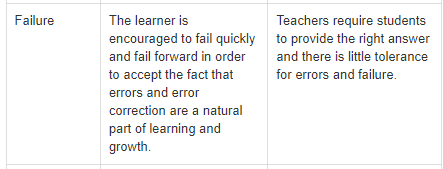
The power of yet is about overcoming the obstacles, fails, and pushing past conformity. If we expect perfection then there is no room for a growth mindset. We do not need to concern ourselves with students feeling lousy because of poor results rather we need to educate them on seeing those moments as what they are lessons. Pocketed moments tailored for the individual to learn; failing needs to be temporary. As an educator, I want to show my failures and I want to guide others through their own. The best way I can model the power of yet is being transparent with my own learning.

Question 3: What other factors need to be considered if you wish to have an impact on the Growth Mindset?
I have alluded to learning environments and learning philosophies; let's explore their impact.

Learning Environments is the authentic creature of a culture revolving around learning.
For example, my innovation plan relies heavily on the use and acceptance of both native and second language. In an affective learning environment, my learners will use both languages to support learning. This influences their mindset, because it removes the obstacles and barriers of not connecting with others. Everyone is learning a second language while maintaining their native, the unanimous struggle creates a unity and promotes success for oneself and others. By using both languages, English Language Learners do not feel overwhelmed with putting effort as a means to catch-up, instead it is to develop at their own pace.
In a learning environment, learners will know the goal and ignite a passion to learn. They will be prepared for challenges and obstacles. The next stage is making a desired outcome and purpose. Learners connect the passion with what they want to create. The effort is preconceived and the mind is ready to achieve its goal. Finally, the action of learning through play creates success amongst the culture and allows for purposeful feedback.
Learning Philosophy- Constructivist overlaps with having a growth mindset. The idea is to use the readers experiences, personal views and cultural program to learn (Brau). The implementation of passion entices learners to explore concepts for learning, not for completion. When challenges are faced during learning, the growth mindset allows for understanding of mistakes for a greater purpose.
Question 4: How can we move our learners toward reigniting or adopting a Learner's Mindset?
Kids with the growth mindset aren't getting better grades ~Hendrick, 2019
Unfortunately, education wants a miracle to close gaps and expedite success; the reality is that learning is a process that is forgiving and evolving. If we limit our beliefs that grades and standardized results measure learning than we will never develop as a nation. There is this romanticizing of a world full of prodigies and gifted individuals that has askew education. It does not matter how talented one is if development is not factored in.
For example, Texas Teachers Evaluation Support System, T-TESS, is not a one and done observation. Teachers are 'graded' on a 45 minute lesson; however, their score is not static. It is intended to motivate the teacher to improve on a domain throughout the year. The goal is to cultivate a growth mindset. The same should be applied to all learners. There is a goal to achieve. The grade is a placeholder that leads to improvement; with feedback learners can reach results.
When we move to promoting improvement, we influence:
a decrease in cheating. Learners own their learning and take pride in the development of their ideas. Cheating is useless when you are continuously improving your original idea; especially, when it is related to your passion.
decrease the stress of grades. In my own experience, when taking 5302 and 5304, I had the opportunity to resubmit my work when it didn't reflect the outcome I was looking for. Grades are not an evil, it is a tool that can promote growth mindset. When grades are used as checkpoints, we create an environment that promotes choice and ownership.
It is important to move beyond grit; through the use of purposeful feedback, we can promote growth mindset; and simultaneously, removing the stress of achieving immediate standardized results. Remember standardization of learning will never include every learner, it is an expectation that does not consider learners abilities, passions, interest, or contribution to a greater society. When we ignore the development of a growth mindset, we never allow students to move beyond the stage of grit.
Question 5: How can we prevent the growth mindset from becoming a fad or being improperly implemented? Consider how grit can be misused (Hint rigor).
As previously stated, growth mindset is not a miracle solution for problems in life nor in education. For a growth mindset to stay, we need intentional education, situations, and purposes. We need to cultivate learning environments were mistakes are welcomed, expected, and challenged. Just thinking and displaying a growth mindset will not maintain its effect, it will be passed over time and time again.
Bulletin boards, classroom exercises, and catch phrases about the growth mindset are being promoted in lots of school setting ~ Gerstein, 2015
References
Gerstein, J. (2015, September 4). Is "have a growth mindset" the new "just say no". WordPress. https://usergeneratededucation.wordpress.com/2015/09/04/is-have-a-growth-mindset-the-new-just-say-no/
Harapnuik, D. (2013, April 5). Fixed vs growth mindset = Print vs digital informational age. It's About Learning. https://www.harapnuik.org/?p=3627
Hendrick, C. (2019). The growth mindset problem. AEON. https://aeon.co/essays/schools-love-the-idea-of-a-growth-mindset-but-does-it-work
Kohn, A. (2015, August 16). The "mindset" mindset: What we miss by focusing on kids' attitudes. Alfie Kohn. https://www.alfiekohn.org/article/mindset/
Texas Education Agency. (2025). Texas teachers evaluation and support system (T-TESS). TEA. https://teachfortexas.org/


Comments