
Coralis Mollitor
Enriching Second Language Acquisition for Emergent Bilinguals
Applied Digital Learning 2024-25
Growth Mind > More Than a Penny
For the course, learners reflected on their mindset. During this course, I researched and took time to identify my own mindset. Do I have a fixed or a growth mindset? How do I improve my perspective? How do I continue to grow?


Growth Mindset Plan
The concept of ‘grit’ swept education with various teachers and books about students enduring their situations; this theology has evolved to include what happens after survival: growth mindset. A growth mindset is the “belief that your basic qualities are things you can cultivate through your efforts, your strategies, and help from others” (Dweck, 2016, p. 6). Having a growth mindset is understanding that we are not stagnant, we are dynamic individuals that change and develop throughout our experiences, acquisition of knowledge, and empathy. The understanding of growth mindset allows educators and students to promote growth in various areas that education lacks support. Allowing for the development of self, promotes the growth academically.
Four Steps Towards a Growth Mindset
When I first started teaching almost ten years ago, I began my journey with no mentors, no guidance; however, I was a new teacher willing to take everything I learned and run with it. As the years progressed, I became less forgiving towards myself. I had goals, scores, to reach; my beliefs began to comply with the world. Since the pandemic, I have taken time to reflect and gauge my personal life as well as my career. I realized that I needed to change my way of thinking. To combat the clutches of my own mindset, I will use the four steps listed by Scott Jeffrey summary from Carol Dweck’s book Mindset: The New Psychology of Success (2024).
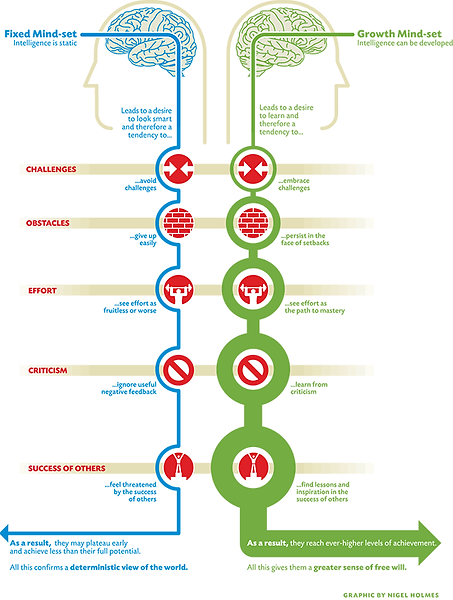

1. Hear the Fixed Mindset (2024): My fixed mindset has always revolved around two of the major categories from the image above: failure and criticism. In my case, they go hand in hand. I tend to see feedback as criticism: I’m not doing enough. It is extremely hard for me to see feedback as positive when I work hard on a project. Insecurities and inadequate feeling convert criticism to failure. Fear of failure weighs heavily on my decisions. I see failure as letting others down; even though it doesn’t stop me from attempting new things, it does cripple my ability to enjoy activities.
2. Choice (2024): Since the pandemic, I have taken to journaling and reflecting on my thoughts. I realize now that my growth mindset has been seeping through. I need to become more conscious about my choices. Recently, my personal life has been filled with life changing events: I started my master's degree, my brother bought a home, and weddings upon weddings. Because of the changes, I have little time to wallow in my thoughts and second guess failing. Now, I am learning to stop and listen to those thoughts that challenge my fixed mind. I know feedback is not criticism, it’s collaboration. Failing isn’t finite. They are lessons; add on reflection, they are problem solving moments and catalyst for creativity. I have the choice to see areas of improvement that I was impervious to and decide what actions I want to take after. It’s only negative, if I decide it to be.
3. Talk with a Growth Mindset (2024): Moment of vulnerability I can be considered hypocritical. I bring myself down. My mind jumps to check off lists of things that need to be done, and hope I am satisfied with the results. Towards others, I squash these thoughts. I can see the opportunities, the potential, and the journey to get there. I have been reflecting; however, I focus on the problems. I need to upgrade my journaling to incorporate areas of improvement. I am going to write the feedback I am given as collaboration to take my ideas to the next level. I have always believed that mentors and seniors should help those learning from them to be at their level. When successors take reign, they will have the experience and knowledge from the previous person already embedded causing the successor to improve from the last position. Knowledge is not a secret that needs to be guarded; learning from others' experience does not prevent us from the same struggles. Both give us tools to succeed where others have not been able too. I have this mindset with my students; I need to apply it outside of my little bubble. This master program is allowing me to build upon ideas that others like me have.
4. Owning Growth Mindset (2024): The master program Applied Digital Learning at Lamar University has been the blessing I need. I am frustrated with education. I saw obstacles and know we are not reaching kids or preparing them for the future they will create. This program continually gives me guidance on improving myself as an educator. What I did not expect is the impact on my self-perception. It has been enlightening and freeing to gain a growth mindset. Listening to an empathetic voice has made every day more enjoyable. Although I am not where I want to be yet, I am enjoying the process it is taking to get there. To be more efficient with growing my mindset, I am going to incorporate goals alongside my reflections. My growth mindset plan is going to incorporate an exercise routine to diminish stress and obtain discipline. My reflections will be weekly noting two glows and one growth. I will take each entry and set a monthly goal or have it relate an overarching goal. I will research habits that I can share with my students and colleagues. I will actively seek others' feedback and apply it. I need to work on the scheduling and scaffolding of the activities, yet I will have a growth mindset.
The Power of Yet
The power of yet is unlocked potential (Dweck, 2014). No one is born knowing everything or having the ability to do everything. As Dweck says “It’s not always the people who start out the smartest who end up the smartest” (Dweck, 2016, p. 5); after a couple of years teaching, I stumbled on this idea as well. I did not have a name for it. While observing gifted and talented students, who have a talent for grasping information, I noticed that some were outpaced by high achievers. The content and environment were the same, the defining factors were determination, resilience, perseverance, and desire or interest. High achievers knew they benefited from repetition of concepts and opportunity to apply their learning. They strived to instantly emerge themselves with the new information; meanwhile, some gifted and talented students relied on their inherited talent to decipher and call upon background knowledge. I learned a lot from high achievers my first year. I took those experiences and used it with all of my students. I had newcomers, special education, and gifted and talented students wanting to learn. They worked together to become resilient. My third grade students stopped asking me when we are coloring in worksheets to looking forward to collaborating in centers and small groups. They wanted to learn. Now, they had the chance.
As I mentioned earlier, grit was the first step to a growth mindset. We need to ensure that we have the resilience to persevere in our fixed mind’s voice. “It's impossible to foresee what can be accomplished with years of passion” (p. 6); we need to grow self-worth. It will help rid the binds of a fixed mindset. The power of knowing you can be more than your limited vision is thrilling. By not accepting a static development, we can allow passion and interest direct the outcome of our potential, learning, actions, and words.
The power of yet and growth mindset are underestimated because the calibration of one’s potential is limitless. The person I am today is not my end version; I have more to learn, refine, and create. We can all improve with each other. The power of yet will cause us to be resilient. We can face any challenge or change. Resilience will make us determined to persevere. We will take in feedback, develop and propel ideas. “Even in the growth mindset, failure can be a painful experience” yet we will survive (p.33). We will set the course and example to those that rise after and with us. The power of yet is knowing that tomorrow is a reattempt.
Implementation of a Growth Mindset
My personal plan to promote a growth mindset will include reflections, exercise, goal making, and learning. Studies show that exercise is a great stress reliever, and the number one factor that determines my mindspace is the stress level I am at. This is a small step that will add to the overall health of my brain. I will partake in yoga during the morning then alternate between other exercises in the afternoon. Next stage of the plan is to make my current reflections purposeful. I was writing whenever I was frustrated and stressed, thus I focused on negative components without adding any value to solving problems. I am very stubborn and unforgiving towards myself; even though I am conscious that I am an improving human being. Therefore, I will reflect every Wednesday. I will focus on two ways I overcame my fixed mindset. I will derive a goal every month to implement either in the classroom, home, or for my courses. I want to deter the fear of failing. I will collaborate with my groups and take their feedback. Finally, I will create blog posts about my reflections or activities that have impacted my growth mindset.
References
Dweck, C. (2016). Mindset: The new psychology of success. New York. Random House LLC.
Dweck, C. [Stanford Alumni]. (2014, October 9). Developing a growth mindset with Carol Dweck. Youtube. https://youtu.be/hiiEeMN7vbQ?si=gDAcpHG5l3V88gsp
Harapnuik, D. (2013, April 5). It’s About Learning. Fixed growth mindset = Print vs digital information age. https://www.harapnuik.org/?p=3627
Jeffrey, S. (2024, April 21). How to change your mindset from fixed to growth: A definitive guide. CEOsage. https://scottjeffrey.com/how-to-change-your-mindset/
Lechnir, N. J, (2023, August 31). Do you have a growth mindset or a fixed mindset. Medium. https://medium.com/@njlechnir/do-you-have-a-growth-mindset-or-fixed-mindset-1df4b8d2cd2e